When you hear the name 'I will follow you into the dark' what do you think its video would be about?
what conventions or stereotypes would you expect to be associated with an indie music video?
what makes you want to watch a music video instead of just listening to the song?
Do you prefer a narrative in music videos, if so or not then why?
How often do you watch music videos and where do you watch them most often?
Has a music video ever persuaded you to buy a song or an album and was there any particular reason?
What are the first things you think of when you hear the term 'Acoustic song'?
I asked these questions in hope that I'd be able to get some information and feedback which would be helpful in designing my music video as I'd be able to find out what people consider the conventions of that style and what they'd expect out of the song itself.
I gathered some existing character designs from indie music videos in order to show the variety of styles used in them. Although silhouettes are commonly used throughout the genre, but by looking at these characters it showed me ways to which I could experiment with colour and art styles making my video more memorable.
I gathered some images of existing images of indie bands so that if I chose to design characters off the band I'd have some examples of indie style and fashion commonly featured with indie artists. Along with this it allowed me to gather some more information on the current indie music scene instead of just the past. Using music Roamer, I made a mind map of similar artists and opened up a few indie artists I knew to show links between them all.
Live performance is a common feature used in Indie music videos due to the idea that it makes the main focus the music itself instead of drawing the audience in with a narrative of the video. Along with this it shows the artist doing what they love and have passion for, considering its more common in Indie or rock genre music for them to care less about success and care more about playing the actually music. Another reason for using live music in their videos is that it shows a natural talent because it hasn't been finely tuned in a studio and it also helps show the passion they have for their music. Live performances in videos as help the viewer experience what the atmosphere is like at one of the shows, making them want to go themselves which will be encouraged by showing people dancing in the crowds as shown by the Black keys video below. Although commonly now artists have started using small narratives between the live performances, making the video more memorable helping them compete with other artists.
Mise-En-scene used in music videos play a large role music videos but especially in Indie videos, along with this in indie videos they commonly follow the 'retro look' which is often related to indie clothes fashion itself. The costumes impact largely on the music videos as conventionally it helps show the audience about the artists or the songs narrative. 'Kitchen sink' Mise En scene is often used in indie music videos as they are commonly set around day to day lives so basic props are essential to be able to great the verisimilitude which makes people relate to the image. Although in the case of Gotye's video below it emphasizes on certain objects and aspects of normal life into a cartoon fashion to make them appear comical to its audience. Sound is obviously important in music videos but added extras change depending on the style. For example if an indie artist chooses to use a live performance it commonly features the crowd screaming in the beginning but by choosing to use a live performance it also helps the audience appreciate their musical talent more. But diegetic sounds are also used to help the narrative in music videos, with the example of Gotyes - easy way out which starts with ambulance sounds in the background and then the alarm ringing as a sign he's about to wake up which are both sounds the viewer is used to making it more relate-able to them.
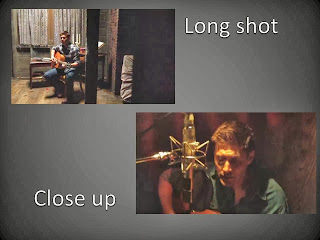
Camera angles in Indie music videos tend to largely use close ups to help express the emotion or lyrics in the song playing, other common camera shots are Long shots to help show the location or the artists themselves and the costume they are wearing, because some artists are known as style icons and the costumes are memorable and make an impression on the audience which can help people remember the music video even more. There is also crane shots mainly used for live performances as it can view the band over the crowd and allow for different angles to be used whilst keeping a smooth transition between the frames.
Using as an example:
Editing wise the must commonly used is a fast cut which allows for the video to change locations swiftly which is often done to the beat to emphasize the song itself, along with this another common editing technique is the fade which works well for slower parts of songs due to it being a gentle edit. Some music videos for the indie genre also use effects on top of the video to add an aged look which often fits in with the vintage theme of costume commonly used in these videos. This is commonly a black and white effect or a sepia effect to make it appear rusty and old.
Before the idea of music videos began, in the 1926 the 'talkies' arrived which included many short film largely featuring music and many featuring bands, vocalists and dancers. Even animation was used in these for example with the animation artist Max Fleischer. This man created 'Screen songs' a series of sing along cartoons which was intended so that the audience would sing along by following the ball on the screen which is similar to karaoke now. This could been seen as the earliest idea of music videos.
This idea was carried on in the 1940's with the introduction of 'Soundies'. Which were 3 minutes films with music showing dance and music performances meant to be displayed on a jukebox like projection system in bars and other public places. Music Videos are often now referred to as 'Promotional videos' or 'Promos' which is to do with the idea of it being used for promotional purposes for the band by making it so the video appeals to a wider audience and can be viewed on different places for example 'YouTube' or TV which helps reach a broader audience. In the past, artists didn't use music videos. Instead choosing to use films originally starting with the example of Cliff Richard's 'Summer Holiday' in which he played a fictitious character but his music was played throughout the film, the served as promotional services before individual videos where made.
The Beatles broke this trend with their series of movies in which they played themselves which was a new concept at the time. With their first being 'A Hard Day's Night', directed by Richard Lester in 1964. Although in 1967 the first generally regarded music video was made for Bod Dylan, which was shot in one continuous shot. Featuring Dylan holding up flash cards and dropping them to show the lyrics playing at the time, this video was the first to start a new trend. Pink Floyd continued this idea of promotional videos especially with their films for their songs including "San Francisco: Film", "Scarecrow", "Arnold Layne" and "Interstellar Overdrive". This idea especially took off in the 70's/80's with the creation of Rock videos, although the term isn't used a much now due to them just being referred to as music videos, this idea became incredibly popular in promoting new bands at the time.
Another moment in music video history was with the two week teen orientated music programs available in Australia in 1974. In early 1974, former radio DJ Graham Webb launched the TV music show which was shown on Sydney's ATN-7 on Saturday mornings; this was renamed Sounds Unlimited in 1975 and later shortened simply to Sounds it became popular and quickly gained a following which caused other countries to follow this idea. In 1978 3 years before the release of The Buggles 'Video Killed on the radio star' on MTV the american program, 'Video Concert Hall' Began showing several hours of un-hosted music videos everyday. The British show 'Top of the pops' show began in the late seventies, although the BBC had strict limits on the number of 'outsourced' videos the show could use. In the 1980's David Bowie had his first UK number one in nearly 10 years which was largely due to the promo video of his song 'Ashes to Ashes'. Although 1975, 'Queen' hired Bruce Gowers to make them a music video for their new single 'Bohemian Rhapsody so it could be shown on Top of the Pops. The American vidoe channel 'MTV' was launched in 1981 which started the era of 24 hour music television.
Conventionally music videos tend to narrate the story featured in the lyrics, commonly by using montage editing to switch between the story and the band members playing. Along with this another convention of music videos is that they generally use close up shots or mid shots to show the emotions or mood of the song overall, that and it allows people to see the band working as promotion for them along with emphasizing the lyrics in the song. Jump cuts and fades are common edits used in music videos as it allows for quick transition between location or with fades used as a change from them. Whilst tracking shots and pans are also conventional to music videos as well. The lighting and props used in music videos depends entirely on the genre of music it is promoting, as a pop music video would probably involve bright and colourful lighting whilst a metal music video would require darker and more dramatic lighting. After analysing some existing media texts for music videos, I was able to notice some common conventions in them. For example the narrative of music videos especially 'Indie' genre ones tend to be formed around the idea of a journey, along with this it generally stems from the idea of being alone and searching for love. If they aren't searching for it love plays a large part in them.